In retail, Christmas isn’t a holiday — it’s the make-or-break period. And sometimes the cost of asking permission is higher than the cost of being wrong.
Caveat: I don’t advocate breaching rules or regulations. The point isn’t the rule-break. It’s the decision-making muscle behind it: a leader who actually did the maths on cost of inaction versus cost of being wrong.
Culture Kings was fitting out its Melbourne flagship, racing to open before Christmas — the window where two-thirds of annual retail profit is made. The storefront design called for black aluminium panels. The council said no.
Most retailers would do the “right thing”. Redesign. Re-submit. Miss Christmas. Tell the board it was “outside our control.”
Beard ran a different calculation. The realistic downside was a fine — a known number. The cost of waiting — missing the Christmas trading window — would have been devastating. So he told the builders to install the panels anyway.
The store opened on time. By the time the council enforced a change two years later, it had turned over more than $20 million.
The interesting part is the framing: most leaders never run the second number — the cost of waiting. They see a risk of being wrong and stop there. The permission loop does the rest: the problem goes up the chain. Manager checks with their executive. Three weeks later the opportunity is missed — not because anyone said no, but because no one moved fast enough.
This drift is one of the patterns I unpack in The Art of Decision-Making.
Fast-paced decisions don’t need to be reckless. Speed is what you get when a leader has quantified both sides of the ledger — the realistic downside and the cost of waiting. It is almost never free. Usually, the business is paying dearly without realising.
A decision to chase a “breakthrough”, led a carbon credit startup to spend half a million dollars on a black-and-white camera with a fancy lens.
From the author: The Art of Decision-Making book is coming soon. But not all case studies have made it into the final manuscript. This one is about a decision-making trap. The moment early success replaces rigour with confidence, scrutiny becomes the first casualty.
There is a particular danger that comes with early, outsized success. Momentum breeds confidence. Confidence, left unchecked, turns into a conviction that the leaders that cracked one hard problem can crack any hard problem, that the judgement which produced the first win can be trusted without the rigour that produced it. Hubris arrives dressed as ambition, accelerates through optimism, and makes itself at home precisely at the moment when pragmatism and scrutiny matter most. The companies that fall hardest are the ones that succeeded too quickly, too easily, and drew the wrong conclusions from it.
A carbon credit startup knew exactly how to win in its niche. Backed by international hedge fund capital, within just a couple of years it had built a focused, scalable model around low-cost emission reductions on gas infrastructure. The formula was working. The revenue was growing exponentially.
Then the founders looked up from what was working and decided to tackle an even bigger problem.
They began the search for the most innovative technology that could redefine how emissions were measured across the oil & gas industry. An expert was hired to scan the frontier, with a brief to prioritise boldness and innovation. Scientific grounding was secondary to ambition.
What they found in the US appeared to fit the brief perfectly. A video-based technology that claimed to distinguish methane and CO2 from other gasses by filming oil & gas flares and power plant smokestacks with real-time quantification of emissions. If it worked, it could redefine global emissions monitoring and unlock hundreds of millions of dollars in investment.
The in-house engineers were unclear about the science behind it. The evidence was scant. But the opportunity was so attractive, that decision to invest was made anyway.
The hunger for a miracle is its own kind of bias. It lowers the bar for scrutiny precisely when the stakes are highest.
Engineers were sent to California to learn the system and validate the results. Half a million dollars and several months later, the verdict arrived. The technology was not what it claimed to be. A visionary team of “inventors” built a black-and-white camera with an unusual lens geometry that was supposed to enable spectral analysis capability. But the best it could produce was blurry monochrome images of flares or smokestacks. It could not distinguish gases. It could not quantify anything. It was a sham.
The financial loss was not the main concern. The founder’s egos suffered more than the balance sheet. The real cost, however, was months of leadership and engineering attention redirected from a pipeline of real but unglamorous opportunities to pursuing unicorns.
This is the pattern the 50:1 framework is designed to catch. The decision to pursue the technology wasn’t buried in the details — it was a clear, visible, leadership-level call. It was a 1%-er. What made it wrong was the objective that drifted from find opportunities that will support our next wave of growth to find a technology that will change everything.
When the search criterion is boldness rather than credibility, you don’t find panacea. You find people selling snake oil.
The right version of this decision — the scientifically-grounded technology search, run with rigour against the actual needs of the business — would have found something valuable. The emission measurement space had real innovation happening. But that search requires a different brief, a different expert, and a different definition of success.
Even boldest of ambitions need an anchor in reality. The 1% decision here should have been to define what “good” looked like before the search began. Get that definition wrong, and no amount of effort, expenditure, or expertise in the field will yield anything of value.
Sometimes the most expensive decision is the one where nobody stopped to ask what problem, exactly, we are trying to solve.
In a winner-takes-all market, the competitive edge wasn’t price or relationships. It was the willingness to delegate decision-making.
From the author: In The Art of Decision-Making book I argue that one of the most counterintuitive 1% decisions a leader can make is to deliberately hand authority to someone else. This case study from commodity trading shows what happens when they do.
In commodity markets, timing is everything. When a finite pool of opportunities exists and the race to secure them is underway, the laggards don’t finish second — they finish with nothing.
This was the reality facing a new business development manager at a major international commodity trading firm, brought in to build a carbon credits business from scratch in Eastern Europe. Competitors were already deep into negotiations on most large-scale opportunities. The time was running out.
What happened next is a case study in finding the real bottleneck and having the courage to remove it.
After half a dozen meetings with senior executives at companies holding carbon credits to offer, a theme emerged. The contract negotiations were a pain point taking many months to conclude. Interestingly, they weren’t stalling on price or relationships — they were stalling on the business model itself.
The traditional setup at most trading firms, including this one, placed the BDM in the role of intermediary. Their job was to sit across from the counterpart, gather requirements, relay information back to headquarters, and wait. Every commercial question went back to the product pricing team. Every contract change went back to legal. The BDM was the face of the firm, but the decision-making power sat entirely with functions that had never been in the room.
The counterparties experienced this as a black box: ask a question, wait a few weeks. Complex dual-language contracts cycling through layers of internal approval on the trading firm’s side meant six months to a year of back-and-forth on a 50-page document was common.
The BDM brought an uncomfortable proposal to the leadership table. What if the model was inverted? Instead of the BDM relaying information back for others to decide, pricing would provide a negotiating range upfront — an Excel model based on key inputs — and trust the BDM to work within it in real time. Instead of legal reviewing every redline in sequence, legal would build a modular contract template the BDM could navigate directly with the client, re-entering the process only when a near-final version was ready for review and formal sign-off.
The shift, while sounded straightforward, in practice, was a dramatic shift in the business model. Pricing and legal teams weren’t just giving up a process step — they were giving up the position of primary decision-maker. The BDM, previously a conduit, would now be running the negotiation end-to-end. HQ would be kept informed, but the day-to-day calls — which clause to flex, which term to hold, how to respond to a counterproposal at 5pm on a Friday — would be made in the field, not in a conference room 10 time zones away from the action.
Both functions had legitimate reasons to be uncomfortable. The controls that remained were carefully designed. But it still required a level of trust that most organisations never extend to the person closest to the client.
The commercial logic prevailed.
The first test came quickly. A major energy utility had been in negotiations with a competitor for over six months. The deal was “getting close”, but the frustration in the room was palpable. The BDM made a bold offer: a draft contract by close of business that day, signed within two weeks, on equivalent commercial terms.
The utility executives were surprised enough to say “send us what you’ve got and we’ll see”.
The contract was signed a month later. Over the following twelve months, a dozen of contracts worth over $200 million were closed through the same approach. By the time competitors understood what was happening and began revising their own processes, the window had nearly closed. Many of the available opportunities had been secured.
The company didn’t win on price or brand or market presence. It won because it solved the counterparty’s real problem, while its competitors didn’t even realise the issue existed.
This isn’t a story about a talented BDM or a clever contract template. It’s a story about a structural decision — specifically, the decision to move authority from the people who knew the most about the product to the person who knew the most about the client.
That inversion is genuinely hard to execute. In most trading organisations, and most organisations full stop, the assumption is that consequential decisions belong with senior specialists — the legal experts, the pricing experts, the people with the deepest technical knowledge. The person in the field is trusted to gather information, not to act on it. Reversing that logic requires functions to voluntarily relinquish something they’ve always held. Under normal conditions, with no burning platform, it doesn’t happen.
What the 50:1 framework asks you to consider is the actual cost of that caution. The 1% decision here was a governance question: who should hold the pen at the negotiating table?
Letting go of authority is uncomfortable. The instinct to keep consequential decisions close to the centre is rational — until the cost of decision-making centralisation becomes visible. When the person closest to the customer has the right tools, the right guardrails, and the right mandate, they can unlock a lot of value.
In this case, it was $200 million in twelve months. And the window closed shortly after.
A well-run marketing machine was delivering results by every measure. Until they looked closer.
The Art of Decision-Making — An Executive Playbook for Nailing the 1% That Drives 50% of Success — is coming soon. In the book, I argue that the hardest part of decision-making isn’t making the right call. It’s recognising which decision actually matters. This case study didn’t make it into the final manuscript, but it’s one of the clearest illustrations of the 50:1 principle I’ve come across: a single, painful decision to stop doing something delivered more value than an entire roadmap of improvements. I’ll be sharing more stories like this in the lead-up to launch.
The dashboards were glowing green. Open rates above industry benchmarks. Unsubscribe rates under control. Cross-sell emails driving the all-important multi-product holding metric. The marketing team at a diversified financial services provider had built a campaign machine that, by every conventional measure, was winning.
Then the analytics team ran a controlled experiment. Nothing dramatic — just randomised holdout groups across every customer communication, designed to measure true incremental lift rather than raw response rates.
The first read-out rewrote the story entirely.
Several campaigns — including some of the team’s strongest performers — were increasing churn. Customers who received the communications were more likely to drop a product or not renew than customers who received nothing at all. The effect spiked around the end of financial year, when customers were already scanning their statements for recurring expenses to cut. A friendly cross-sell email, arriving at exactly the wrong moment, was functioning as a prompt to review — and cancel.
Behavioural scientists call these customers sleeping dogs — relationships that are perfectly stable until you remind the customer they exist. The campaign machine had been waking them up, at scale, for years.
What happened next is where the real decision-making story begins.
The first reaction was disbelief. The second was defence. “Let’s wait for more data.” “Let’s try another creative.” “Let’s at least run the EOFY campaign one more time — it’s already built.” The arguments were reasonable. They were also expensive. Every month of wait-and-see could be measured in lost customers.
This is the trap that the 50:1 framework is designed to expose. The team wasn’t failing to prioritise. They were prioritising the wrong thing — optimising execution of a machine that was pointed in the wrong direction. The critical 1% decision at that stage wasn’t how to run the campaigns. It was whether to run them at all.
Years of habit, targets anchored to send volume, team identities built around campaign excellence — all of it pointed one way, while the evidence pointed the other. Stopping felt like an admission that everything they’d built was wrong.
In the end, the cold-blooded business logic prevailed. The decision was surgical: some campaigns were killed outright, some were paused during renewal windows, some were suppressed for specific cohorts. “Stop sending emails” became, somewhat absurdly, the number-one initiative on the roadmap.
It cost almost nothing. It saved hundreds of customers a month. It was the highest-ROI initiative the team ran that year.
The critical discipline here is about the willingness to pull the handbrake when a number you trust contradicts a narrative you love — and to recognise that removing a line from the roadmap can be the most important decision.
That’s what nailing the 1% actually looks like in practice. Not a bold strategic pivot or a visionary bet. Sometimes, just the courage to stop.
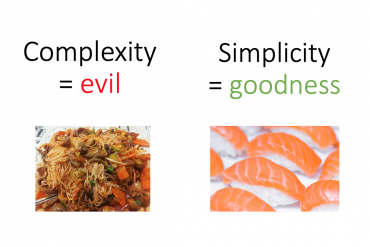
Complexity in life (difficult relationships, trying to please everyone, financial troubles) drags us into anxiety and depression.
Complexity in business (tricky op models, chasing too many opportunities, convoluted offering) makes it hard to manage and impedes growth.
We often try to solve complex issues with complex solutions. But evil cannot be defeated by evil. Complex solutions only multiply our grief.
Solutions must be simple. Unfortunately, simple is HARD. A simple way is uphill – it takes courage and effort.
For those who remember pre-cloud days, file sharing across PCs was at best cumbersome. In came Dropbox and solved it by adding a cloud folder to our desktop. Behind this ultimate simplicity was a sophisticated piece of tech which took months of hard work to develop.
Simplicity is goodness. It brings clarity and comfort.
Every day we face choices that make our life a bit simpler or a bit more complex. It’s worth being mindful of the paths we choose.
What can we simplify today? Make the first step to mend a complex relationship? Clean up inbox? Reject a meeting to have a proper lunch and recharge? Kill a pet project that distracts us from what’s important? 👇
Cutting to the chase, two things define our career trajectory – our abilities to problem-solve and self-develop.
PROBLEM-SOLVING is about converting intellectual horsepower (IQ) into value. Like most good things in life, IQ is unfairly distributed. But, some succeed by extracting 100% out of a modest gift, while others “waste” talent by using 5% of a huge endowment.
Nailing problem-solving in our area of expertise gets us to brilliance.
SELF-DEVELOPMENT is about putting conscientiousness (one of 5 personality traits) into action and becoming a slightly better person / leader every day. Again, it’s a function of capacity (inherent) and will (choice) to change.
Excelling at self-development (personal productivity, communication, leadership, etc.) makes a good leader.
For those who master both – the sky is the limit.
To move RIGHT out of the “grey box” we invest in core crafts (usually early in our career), which requires letting go of know-it-all attitude. As we progress, self-development becomes key to growing UP, which requires leaving the ego behind.
While general intelligence and conscientiousness may be the best psychometric predictors of career success, it’s up to us to get the most out of our talents and traits.
I’ve always felt the “80:20” principle is overrated. Working 70-hour weeks on intense strategy consulting gigs, I wondered why I was getting smashed despite religiously focusing on the proverbial top-20% of causes that drive 80% of effects. My natural laziness helped me realise the principle needs a small tweak that makes it 20x more powerful.
Think of it as effort (input) vs value (output). If a complex problem takes 100 hours to fully solve, by focusing on the highest-priority elements, in 20 hours you can crack 80% of it.
But here’s the trick: 80:20 applies to those 20 hours as well. By spending only 4 hours (20% of 20), you tackle 64% of the problem (80% of 80%). And it doesn’t stop there. With the right focus, in under 1 hour (20% of 4), you can smash over half (~51%) of the problem.
That’s the 50:1 magic. One hour of prioritised effort yields more than half the value that 100 hours would produce.
It’s a power law of nature. 1% of Wikipedia editors produce 77% of the content. In classical music, four composers — Bach, Beethoven, Mozart, Tchaikovsky — wrote most of what orchestras still play today. Over 50% of global wealth is owned by 1% of the population. Fighting this law is like fighting gravity. Why fight when we can use it?
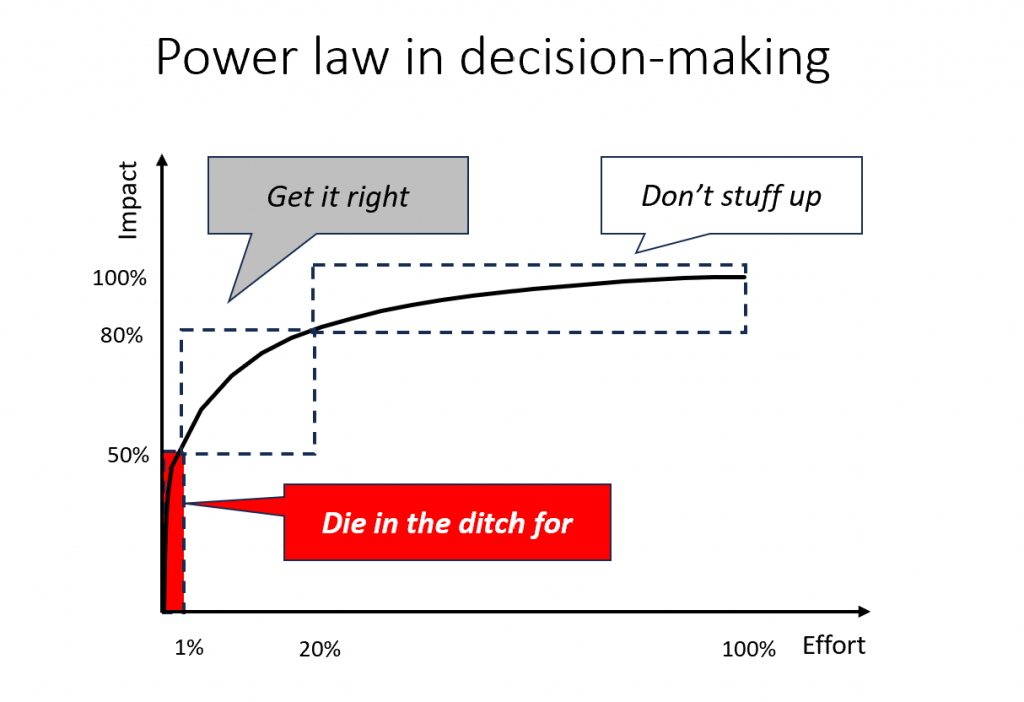
In the context of decision-making: 50:1 isn’t as much about time as it is about decisions. A tiny fraction of the choices — the 1% — determine 50% of the outcome. Get those right and you’re halfway to success. Get them wrong and no amount of effort on the remaining 99% will save you.
Now, let’s break it into three tiers of decisions:
Die in the ditch for — the critical 1%. Hard-to-reverse, direction-setting calls. These deserve disproportionate leadership attention.
Get it right — the next 19%. Important, but second-order. Delegate to capable hands and stay close enough to course-correct.
Don’t stuff up — the remaining 80%. Inconsequential individually. Delegate further, pick a default, automate. Don’t let them eat your day.
The trap many leaders fall into is spreading effort across the whole 100%. Good leaders focus on the 20% — which is good, but their priority window is still 20x too wide. The most effective leaders focus on the 1% that matters most.
And the 1% isn’t only a CEO concern. It applies at every level. The CEO’s 1% might be capital allocation. The GM’s 1% is the product roadmap. The marketing lead’s 1% might come down to a single headline. Whatever the role is, find your own 1% — because 50% of success hinges on nailing it.
So the first question worth asking on Monday morning: what’s the 1% in front of me now?
That question is the foundation of The Art of Decision-Making. The full 50:1 method, including the Who, How, Why, What toolkit, is unpacked across 12 chapters.
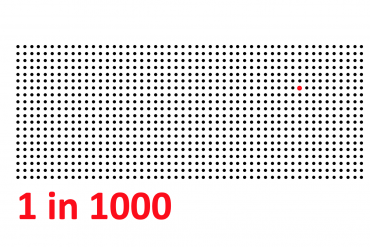
Famous Apple’s mantra that in designing a product for every “YES” there are 1,000 “NOs” can apply to the way organisations manage their “ideas portfolio”. By idea I mean a new project or proposition, which requires involvement and buy-in from multiple people, and has an uncertain outcome, i.e. not a proven concept where success primarily depends on the quality of execution.
Over the past decade companies have done well empowering staff and facilitating ideation across all parts of organisation – just look at all the hackathons around. The new challenge is how not to drown in hundreds of zombie mini-initiatives and pet projects that impact productivity and distract resources from what’s important.
Interestingly it’s often our politeness and political correctness that stand in the way of innovation and create waste. We tend to label ideas “good” even when we don’t believe they have any merit, but don’t want to hurt anybody’s feelings. Proliferation of these “good ideas” can become a real problem – everybody is busy on “projects” that achieve nothing.
“Good ideas” from senior ranks have more chances of being implemented. But where these ideas get a go-ahead, staff often see them as fads and let them perish slowly as a forgotten pilot or a half-done initiative not even worth a post-implementation review. Despite the waste, these failed projects can be a weird source of satisfaction: the sceptics are happy because they knew it was a dud. The author still gets some sense of accomplishment and easily finds someone or something to blame. “Good ideas” keep flowing. The cycle goes on.
Ideas coming from junior staff don’t get as many chances. The authors are politely told that their idea is interesting and may need a bit more work. And they keep working on it. After a while it becomes apparent that it won’t ever get up, which can make staff disengaged and resentful – “everybody likes it, but the stupid company can’t get their act together”. The cycle goes on, until that person loses hope and stops bringing up ideas or moves on.
It doesn’t have to be that way. Strategically organisations experiencing these problems need to relentlessly focus on the few opportunities that have best chances of making a difference. Such focus may entail significant cultural adjustments, embedding which takes time and discipline.
Four aspects of corporate culture are particularly important in avoiding the “good idea” trap:
Culture of open communication and feedback is a must. If the company does not encourage constructive conversations – it has to accept waste. The other extreme is a culture of cynicism and criticism, which is even more destructive. The golden middle is when it’s a norm to have thorough fact-based debates and accept feedback with a “thank you” rather than “yes, but”. This feedback filter should tackle the first 990 out of 1,000 “good ideas”.
Culture of transparency and consistency in decision making that is based on merit, not hierarchy, is key to expectation management. If an idea is “great enough” to be seriously considered, understanding of the process and odds of it getting through will soften the blow for the other 9 out of 10 remaining ideas.
Culture of celebrating success and sharing credit for 1 in 1,000 idea that gets up. Not everybody will produce a billion-dollar idea, but anybody can take part in designing, refining and bringing it to life. Spreading the credit of success wide doesn’t cost anything, but has tremendous effect on engagement and creativity.
Last but not least, culture of letting “good ideas” go. Leaders must learn to kill their “good ideas” fast, leading teams by example into a brave new world where only 1 in 1,000 makes it. When a leader is getting polite feedback that their idea is “not technically or legally feasible, but with some work may be useful elsewhere”, a response should be to kill it and focus on feasible and impactful opportunities.
And the best place to start making a difference is… ourselves. Keeping an open mind to all feedback in pressure testing ideas is a key first step. If it’s not quite “1 in 1,000” let it go quickly, there are better things in life than pursuing our own unicorns. If it is – make it happen and generously share credit for success.