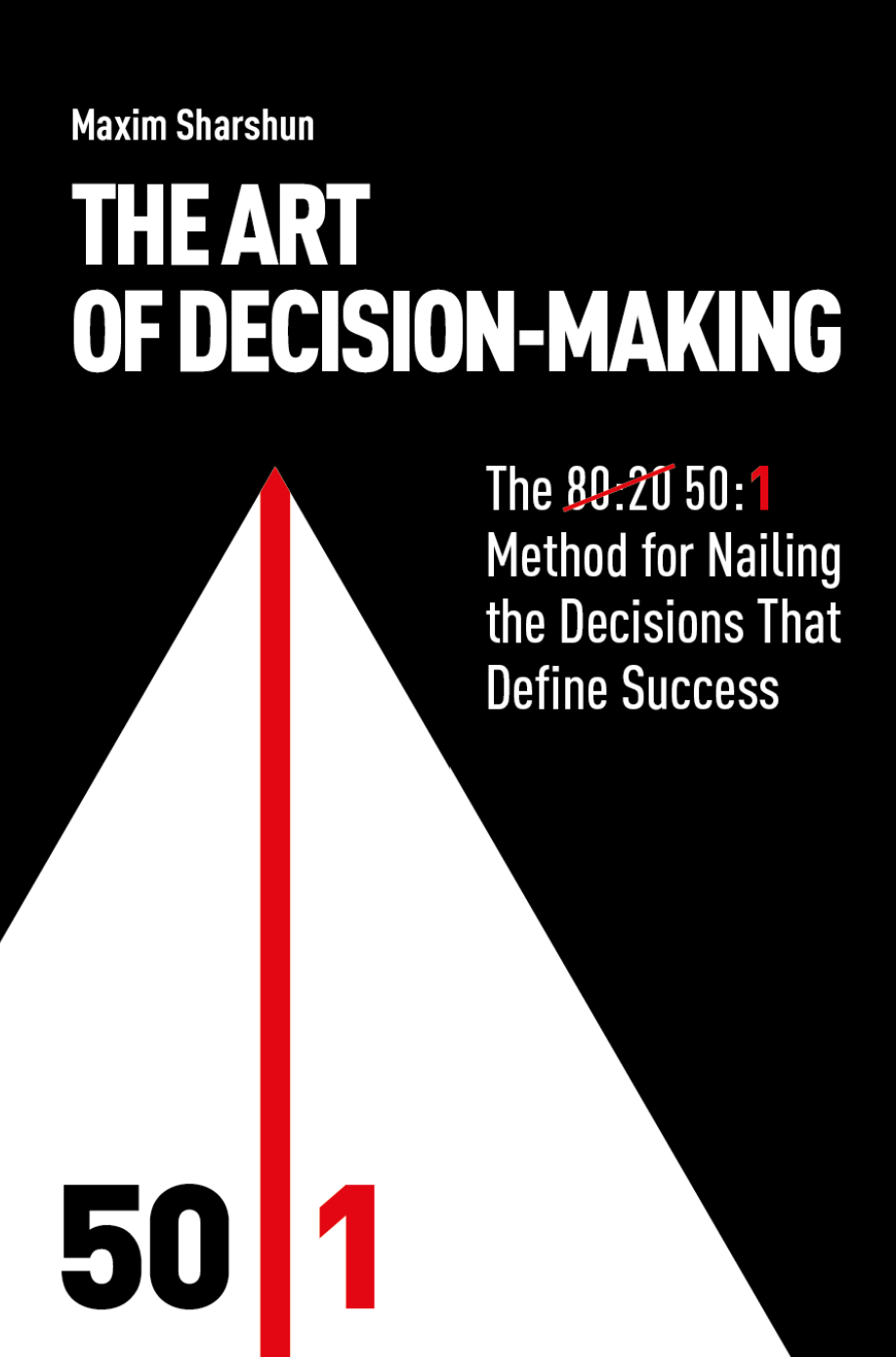
The Art of Decision-Making
The 50:1 Method for Nailing the Decisions That Define Success
by Maxim Sharshun
Synopsis
Every organisation runs on two things: deciding and executing. We pour enormous resources into execution — agile delivery, lean operations, change management, governance. But when it comes to making the critical calls that actually determine whether the strategy succeeds or fails? Even the most capable leaders wing it, overthink the trivial, and sleepwalk through the consequential.
This book introduces the 50:1 Method — built on a simple insight, the 50:1 Rule: ~ 1% of decisions drive ~50% of outcomes. That radical imbalance means the quality of your critical choices is disproportionately important. The art of leadership lies in spotting that 1% and nailing it.
The Decision-Making Pyramid and 1% Frontier are the lenses for spotting that irreversible and highly consequential 1%. The Who–How–Why–What toolkit is how you crack it: bringing the right people, building the right culture, framing the right question, and running the right analysis.
The Art of Decision-Making is the battle-tested executive playbook. It’s packed with real-world case studies from financial services, loyalty, technology, and energy — and it delivers on a simple promise: 100% content, 0% filler.
Chapter guide
Part I: Setting the Scene
Chapter 1: The Two Dimensions of Business
Any organisation exists by doing just two things — deciding and executing. Most get the balance catastrophically wrong.
Chapter 2: Decision-Making and Strategy
The link between strategy and decision quality — and the staggering cost of getting it wrong.
Chapter 3: The 50:1 Rule
Why 1% of decisions drive 50% of the outcome — and how to apply this radical lens to your work and life.
Chapter 4: What Is the “1% to Die For”
The decision-making pyramid, the reversibility–criticality matrix, and how to find the needle in the haystack.
Chapter 5: The Method of Nailing the 1%
Where existing frameworks fall short — and why you need a comprehensive toolkit, not a single tool.
Part II: The Method
Chapter 6: The “Who”
What makes a great decision-maker, how to build make-magic-happen teams, and getting the right capability mix.
Chapter 7: The “How”
Creating a culture of Focus, Openness, Clarity, and Speed (FOCS) — the operating system for quality decisions.
Chapter 8: The “Why”
Setting objectives, constraints, and guiding principles — and making sure you’re solving the right problem before solving it.
Chapter 9: The “What”
The analytical process: generating options, evaluating trade-offs, debating, committing, and executing.
Chapter 10: Decisions in Complex Systems
Navigating interdependent decision webs, the sudoku method, and a practical approach to capital budgeting.
Part III: The Treatment Plan
Chapter 11: Why Good Organisations Make Bad Decisions
The six mortal sins, operating model failures, cultural traps, cognitive biases, and the three mindset viruses.
Chapter 12: Leading Organisation from Good to Great
Leadership standards, building decision-making capability, aligning incentives, and knowing when to throw out the playbook.